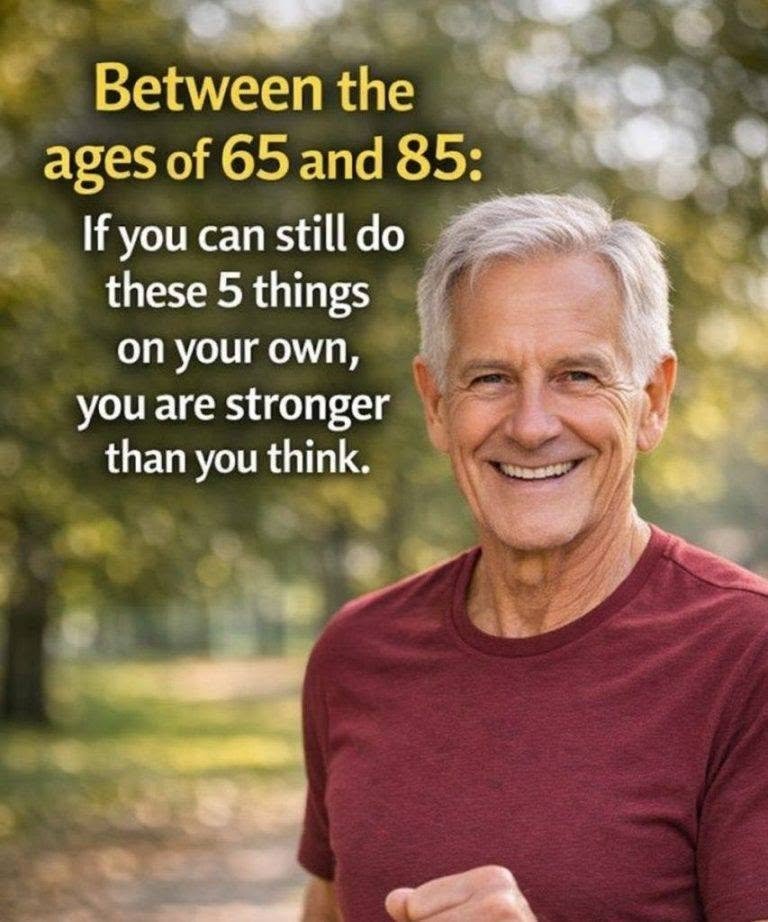

Between the ages of 65 and 85: if you can still do these 5 things on your own, you’re stronger than you think
Reaching the decades between 65 and 85 brings natural shifts in energy, muscle mass, balance, and cognitive processing speed. Yet, aging does not affect everyone at the same pace. While chronological age simply counts the years you have lived, functional age measures how well your body and mind actually perform in daily life.
If you are between 65 and 85 and can still perform the following five everyday activities completely on your own, your physical resilience, neurological health, and overall vitality are far stronger than average.
1. Standing Up from a Chair Without Using Your Hands
Why it matters: Getting up from a seated position without pushing off the armrests, your thighs, or a nearby table is one of the strongest indicators of lower-body strength and longevity.
What it reveals about your body:
-
Core and Leg Power: Rising smoothly from a standard-height chair relies heavily on your quadriceps, glutes, hamstrings, and deep abdominal muscles. Preserving fast-twitch muscle fibers in your legs protects you against frailty.
-
Joint Mobility: It shows that your hips, knees, and ankles still retain healthy flexibility and shock absorption without debilitating stiffness.
-
Fall Prevention: Strong leg muscles act as your primary defense against slips and trips, allowing you to catch yourself before a stumble turns into a serious fall.
2. Balancing on One Foot for at Least 10 Seconds
Why it matters: Single-leg balance is a simple test that medical researchers frequently use to assess overall health and long-term survival in older adults.
What it reveals about your body:
-
Brain-Body Communication: Staying upright on one leg requires instant coordination between your inner ear (vestibular system), your eyes, and the sensory nerves in your feet and ankles.
-
Stabilizer Muscle Strength: It demonstrates that the small, often overlooked stabilizing muscles around your ankles, hips, and lower back are still active and responsive.
-
Cardiovascular and Neurological Health: Difficulty maintaining brief balance can sometimes be an early sign of subtle nerve or circulation changes, so passing this test effortlessly signals a well-regulated nervous system.
3. Carrying Groceries or a Heavy Bag Up a Flight of Stairs
Why it matters: Combining weight-bearing movement with an incline tests both your muscular endurance and your cardiovascular capacity at the same time.
What it reveals about your body:
-
Heart and Lung Efficiency: Climbing stairs while carrying a load—such as a couple of full grocery bags or a laundry basket—pushes your heart rate up. Being able to reach the top without severe shortness of breath or dizziness proves your heart and lungs are delivering oxygen efficiently.
-
Grip Strength: Holding onto handles without your hands cramping or tiring quickly is directly tied to overall upper-body vitality and nervous system health.
-
Bone Density: Weight-bearing activities place healthy stress on your spine, hips, and legs, helping keep your bones dense and resilient against fractures.
4. Managing Your Own Medications, Bills, and Daily Schedule
Why it matters: Physical strength is only half of independence; sharp executive function is what keeps you safely in control of your life.
What it reveals about your mind:
-
Working Memory and Focus: Remembering which pills to take at what time, tracking due dates, and organizing appointments require active short-term memory and sustained attention.
-
Problem-Solving Skills: Handling household finances, spotting billing errors, or adapting when plans change shows that your brain’s frontal lobe—the command center for decision-making—is firing well.
-
Cognitive Reserve: Staying mentally engaged with real-world responsibilities builds neural pathways that help protect against cognitive decline.
5. Getting Down to the Floor and Standing Back Up Again
Why it matters: The ability to lower yourself to the ground and rise back up unassisted is widely considered the ultimate full-body mobility test for older adults.
What it reveals about your body:
-
Full-Body Coordination: This movement demands synchronized effort from your shoulders, core, hips, knees, and ankles all at once.
-
Flexibility and Range of Motion: Tightness in the lower back or hips often makes getting off the floor difficult. Doing it smoothly proves your joints move freely through a wide range of motion.
-
True Self-Reliance: Beyond fitness, this skill provides profound peace of mind. Whether you drop something under a bed, want to play with grandchildren on the rug, or experience a minor slip, knowing you can get back up on your own preserves total autonomy.
Maintaining these five abilities between 65 and 85 is no small achievement. They represent a combination of muscular strength, cardiovascular endurance, balance, flexibility, and mental sharpness that allows you to live on your own terms. Continuing to walk daily, lift light weights, stretch, and challenge your brain will help protect these strengths for many years to come.