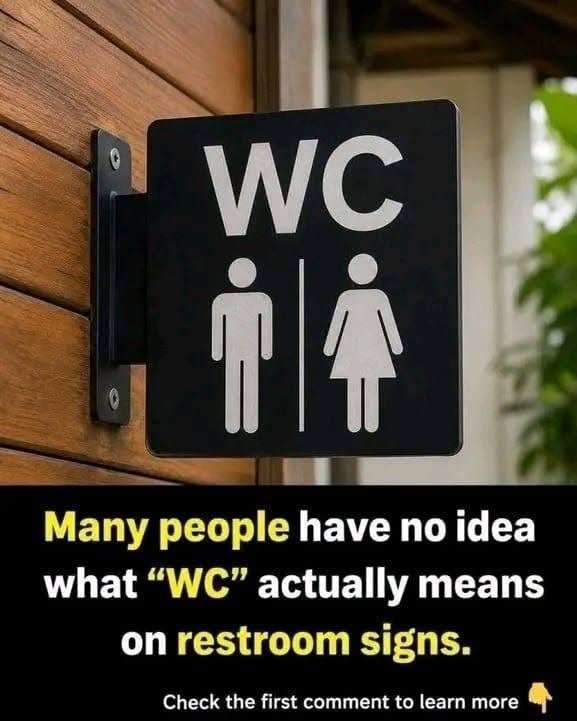

What Does “WC” Actually Stand For? The Toilet Sign Mystery Finally Solved!
If you have ever traveled across Europe, Asia, or older historic buildings around the world, you have almost certainly seen the two-letter abbreviation “WC” posted on a bathroom door. While most travelers quickly figure out from context that those letters point to the restroom, many people never learn what the initials actually stand for—or why such a simple, practical phrase became a global standard on bathroom signage.
WC stands for “Water Closet.”
Far from being a modern code or a foreign acronym, “Water Closet” is a nineteenth-century English term that originally described a small, private room equipped with a flushable toilet connected to a water supply and drainage pipe. Over the past two centuries, the full phrase gradually fell out of everyday spoken English, yet its two-letter abbreviation survived and spread across dozens of languages worldwide.
The Historical Origins of the “Water Closet”
To understand why early toilets were called water closets, it helps to picture how sanitation worked before indoor plumbing existed.
1. Life Before Indoor Plumbing For centuries, people relied on outdoor outhouses (often called privies), chamber pots kept under beds, or wooden commodes inside bedrooms. Because these setups had no running water or sewer connections, waste had to be emptied manually, creating persistent odor and hygiene challenges.
2. The Invention of the Flush Toilet Although early prototypes of flushing mechanisms appeared as far back as the late 1500s—most famously designed by Sir John Harington for Queen Elizabeth I—indoor flush toilets did not become practical until the Industrial Revolution. In 1775, Scottish inventor Alexander Cumming patented the S-trap pipe design, which held a small pool of water in the bend of the pipe to block foul sewer gases from rising back into the house. Shortly afterward, English locksmith Joseph Bramah improved the flush valve mechanism, making indoor toilets reliable for wealthy households.
3. Why “Closet”? In eighteenth- and nineteenth-century English, the word “closet” did not refer only to a wardrobe for hanging clothes. Instead, it meant any small, enclosed private room—such as a study, prayer room, or dressing alcove. When homeowners converted a tiny spare room or alcove into a dedicated space housing one of the new water-flushed toilets, they naturally called it a “water closet” to distinguish it from a dry earth closet (which used soil or ash instead of water) or a storage closet.
How “WC” Became an International Symbol
By the late 1800s, Victorian society considered direct references to bodily functions impolite in polite conversation. Saying “water closet” sounded refined and discreet, and abbreviating it to “WC” on architectural blueprints and public building signs made it even more understated.
As British engineering, railway networks, hotels, and plumbing technology expanded globally during the nineteenth and early twentieth centuries, the abbreviation traveled with them:
-
Architectural Blueprints: Architects around the world adopted “WC” as a compact, universal label to mark bathroom spaces on floor plans.
-
European Adoption: Countries such as France, Germany, Italy, Spain, Poland, and the Netherlands adopted “WC” directly onto public signs—even though the words in their own languages were completely different.
-
Global Travel: Train stations, airports, cafes, and older hotels kept the “WC” sign because international visitors could immediately recognize those two letters regardless of what language they spoke.
Why “WC” Is Still Used Today While “Water Closet” Disappeared
In North America and parts of the English-speaking world, polite euphemisms continued evolving throughout the twentieth century. People shifted from “water closet” to “lavatory,” “washroom,” “restroom,” and “bathroom.” Today, almost nobody in everyday conversation says they are going to the water closet—except occasionally in real estate listings, where a small enclosed toilet stall inside a larger master bathroom is still sometimes labeled a “water closet” or “WC” on floor plans.
Meanwhile, across continental Europe and many parts of Asia, “WC” remained frozen in time as a clear, neutral, non-language-specific sign. Because it requires no translation and fits neatly on a small door plaque, those two Victorian initials continue guiding travelers every single day.