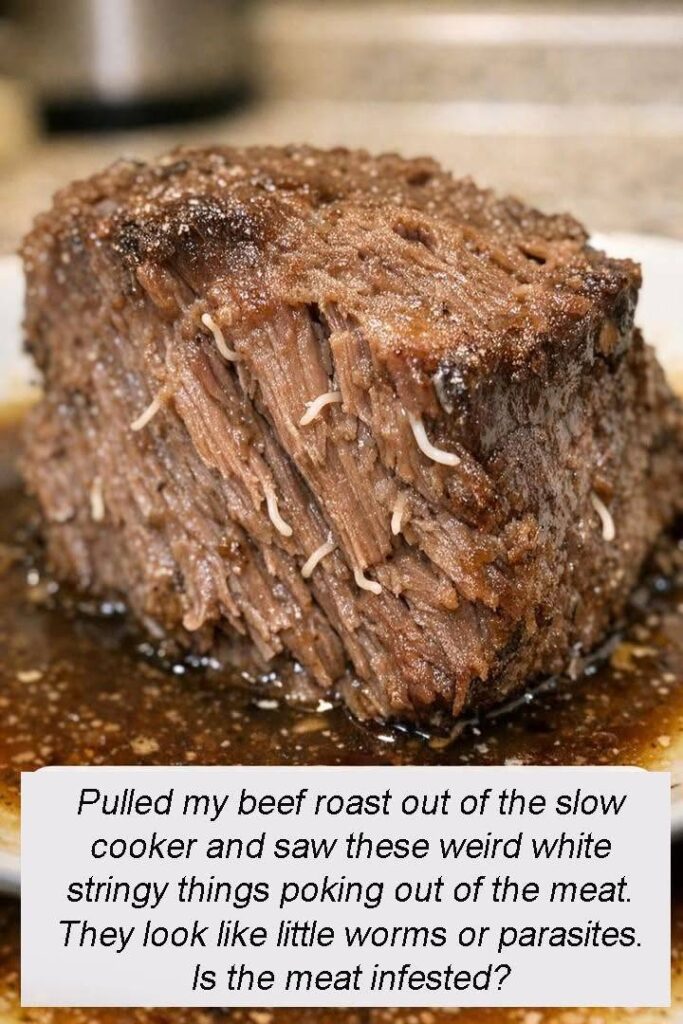

White Stringy Things in Cooked Beef Roast: What Could They Be?
Finding thin white strands sticking out of a beef roast after slow cooking can be alarming, especially when they resemble tiny worms. However, the appearance alone does not mean the meat was infested with parasites. Slow cooking can make connective tissue, collagen, fat, and muscle fibers much more visible.
1. Connective Tissue and Collagen
The most common explanation is connective tissue. Beef contains natural strands of collagen and other connective tissues that hold muscle fibers together.
During slow cooking, collagen gradually breaks down and becomes soft and gelatinous. Some portions can remain as pale, stringy strands that protrude from the meat.
Solution: If the roast otherwise looks and smells normal and the strands are clearly part of the meat, you can trim away any unpleasant-looking pieces before serving.
2. Fat Can Look Strange After Cooking
Beef fat can appear white or pale, especially after it cools. Fat may collect between muscle fibers or form soft strands and pieces throughout the roast.
Solution: Remove larger pieces of excess fat with a clean utensil if you don’t want them. This is a normal quality issue rather than evidence of parasites.
3. Muscle Fibers Can Separate
A slow-cooked roast becomes tender because its muscle structure breaks down. Individual muscle fibers can separate and appear as long, pale strands.
This can be especially noticeable when you pull the roast apart with forks.
Solution: Shred or slice the meat normally. If the strands are simply part of the cooked muscle, they are not a sign that the roast is infested.
4. Could It Actually Be a Parasite?
Some parasites can infect beef, but you should not try to diagnose a parasite based only on something that looks like a worm. A photograph or visual inspection may not be enough to identify an organism with certainty.
If the material appears to be a separate organism rather than a strand of meat, don’t eat that portion while you’re trying to determine what it is.
Solution: Stop serving the questionable meat, refrigerate it safely, and contact your local food-safety authority, butcher, or a qualified food professional if you need identification. A clear photograph can also help with an initial assessment.
5. Check the Meat for Other Warning Signs
Look at the roast as a whole rather than focusing only on the white strands.
Be more cautious if you notice:
- A strong or unpleasant odor
- A slimy or unusually sticky texture
- Unusual discoloration that doesn’t resemble normal cooked beef
- Mold-like growth
- Packaging that was swollen or leaking before cooking
- Meat that was stored improperly or left unrefrigerated for an extended period
If several warning signs are present, don’t try to rescue the meat by cooking it longer. Discarding questionable meat is safer.
6. Make Sure the Roast Was Cooked Properly
For a whole beef roast, use a food thermometer to check the internal temperature rather than relying only on cooking time or appearance. The appropriate safe temperature depends on the type and preparation of the beef.
Slow cooking should also be done according to the appliance’s instructions, with the meat kept refrigerated before cooking and not left sitting at room temperature for prolonged periods.
What Should You Do Right Now?
If you have already removed the roast from the slow cooker and are concerned about the white strands:
- Don’t eat the questionable pieces yet.
- Examine whether the strands are attached to the meat or appear completely separate.
- Check the roast for unusual odor, slime, discoloration, or other spoilage signs.
- If the meat otherwise looks normal and the strands appear fibrous and connected to the roast, they are more likely to be connective tissue, fat, or muscle fibers.
- If something genuinely looks like a separate worm or organism, set the meat aside and have it professionally assessed rather than guessing.
- If you are uncomfortable with the meat or cannot determine what the material is, throw it away. The cost of a roast is not worth taking a food-safety risk.
The Bottom Line
White, stringy material in a slow-cooked beef roast is often normal connective tissue, collagen, fat, or separated muscle fibers—not necessarily parasites. Slow cooking can make these structures much more noticeable.
If the material looks genuinely separate from the meat or you see other signs of spoilage, don’t eat the roast until you have determined what you’re dealing with. When in doubt, discarding questionable food is the safest solution.