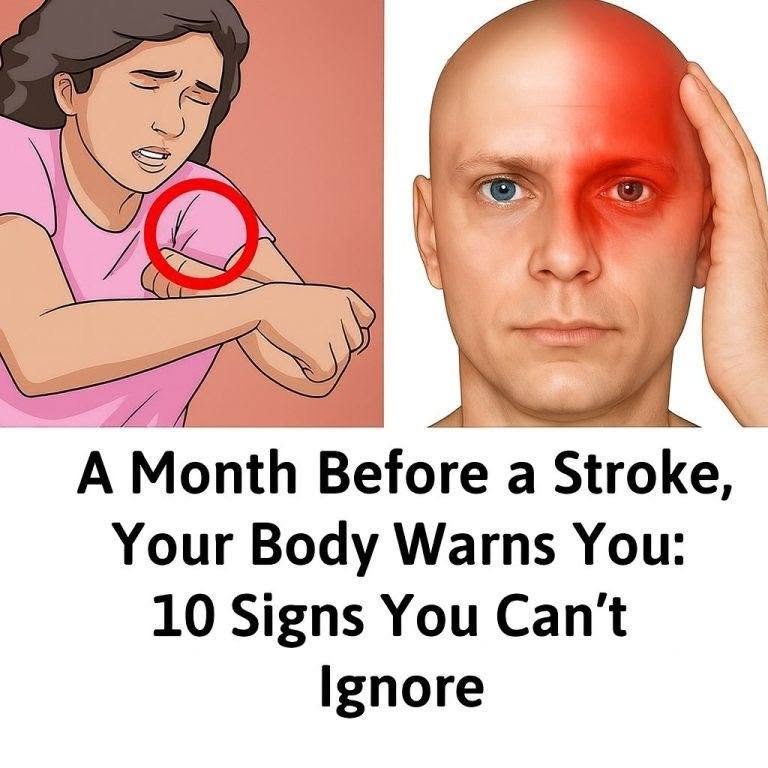

A Month Before a Stroke, Your Body Warns You: 10 Signs Not to Ignore…
Important Medical Context
-
Most Strokes Happen Suddenly—Not With a 30-Day Countdown: A stroke occurs abruptly when blood flow to part of the brain is blocked or a blood vessel ruptures. There is no universal “one-month warning clock.”
-
Early Warning Signs Are Often Mini-Strokes (TIAs): What people sometimes notice days or weeks before a major stroke is a Transient Ischemic Attack (TIA)—a temporary blockage causing stroke-like symptoms that fade within minutes to hours, yet signal a high short-term risk of a full stroke.
10 Warning Signs That Require Urgent Medical Evaluation
-
Sudden One-Sided Face Drooping or Asymmetry: One side of the face droops, feels numb, or looks uneven when trying to smile.
-
Sudden Weakness or Numbness in One Arm or Leg: Unexpected heaviness, tingling, or inability to lift or hold up one arm or leg—typically affecting one side of the body.
-
Sudden Slurred Speech or Difficulty Finding Words: Speech sounds garbled, unclear, or you struggle to form sentences or understand what others are saying.
-
Sudden Vision Changes in One or Both Eyes: Abrupt blurred vision, double vision, or temporary darkness/curtain-like vision loss in one eye (amaurosis fugax).
-
Sudden Loss of Balance, Coordination, or Dizziness: Unexplained vertigo, stumbling, trouble walking straight, or loss of coordination without an obvious inner-ear cause.
-
Sudden Severe Headache With No Known Cause: An abrupt, intense headache (“thunderclap” pain), sometimes accompanied by nausea, vomiting, or neck stiffness.
-
Brief Episodes of Stroke-Like Symptoms That Resolve (TIA): Any temporary numbness, speech trouble, vision loss, or weakness lasting only a few minutes—even if you feel completely normal afterward.
-
Sudden Confusion or Disorientation: Abrupt difficulty comprehending familiar surroundings, instructions, or simple tasks.
-
Sudden Trouble Swallowing (Dysphagia): Unexpected difficulty swallowing liquids or food paired with neurological symptoms like facial weakness or slurred speech.
-
Unexplained Fainting or Sudden Drop in Alertness: Abrupt loss of consciousness, severe drowsiness, or unresponsiveness alongside other neurological changes.
Emergency Action Rule: BE FAST
-
B – Balance: Sudden loss of balance or coordination.
-
E – Eyes: Sudden blurred, double, or lost vision.
-
F – Face: Facial drooping or unevenness on one side.
-
A – Arms: Weakness or drifting downward in one arm.
-
S – Speech: Slurred, strange, or difficult speech.
-
T – Time: Call emergency services immediately—even if symptoms disappear after a few minutes.