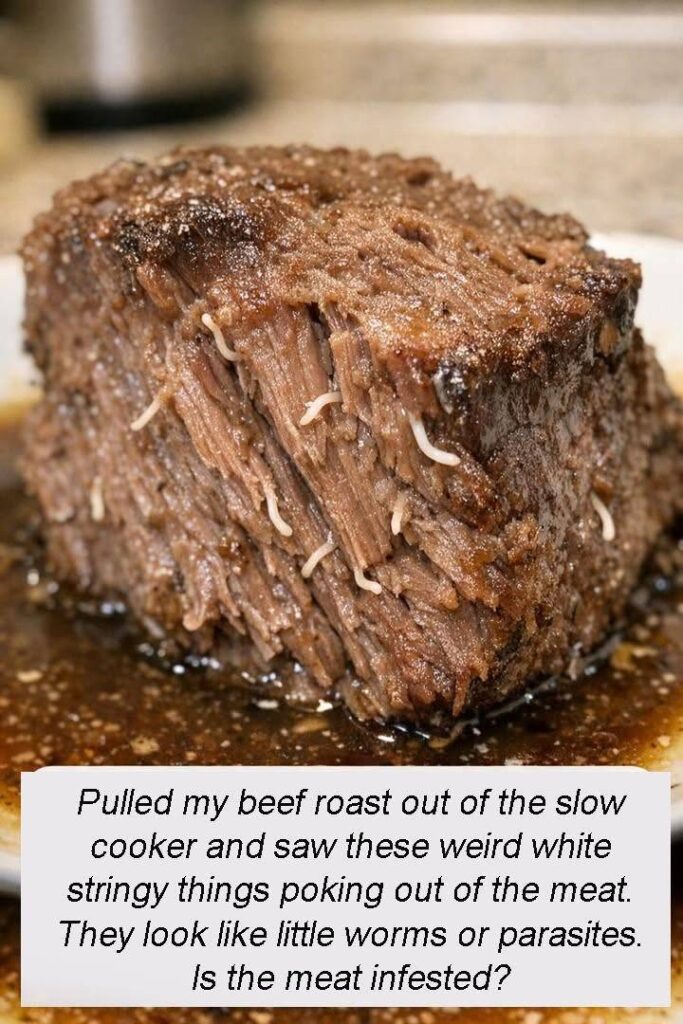

White Stringy Things in a Beef Roast: Are They Worms or Parasites?
Finding thin white or pale strings sticking out of a slow-cooked beef roast can definitely look alarming, but in most cases, they are normal parts of the meat rather than worms or parasites.
What Are the White Strings?
Beef contains connective tissue made largely of collagen. Some cuts also contain bands of fat and tough membranes between muscle groups. During slow cooking, these tissues soften and can separate from the meat, making them much more noticeable.
The strands may look:
- White, cream-colored, or slightly translucent
- Stringy or fibrous
- Tough before cooking but soft after prolonged cooking
- Attached firmly to the roast rather than moving independently
- Similar to thin threads running between sections of muscle
Collagen can also turn into gelatin during slow cooking, which explains why some parts of a roast can look slippery, stringy, or jelly-like.
Why Do They Look Like Little Worms?
The shape is often what makes people concerned. A long, thin strand of connective tissue can resemble a worm when it sticks out from cooked meat.
A useful clue is how it is attached. Normal connective tissue is integrated into the meat and generally tears or pulls apart along the muscle fibers. It does not behave like a separate creature.
Could Beef Actually Contain Parasites?
Beef can carry certain parasites, which is why proper food handling and cooking are important. However, seeing a few white strands in a cooked roast does not by itself mean the roast was infested.
You should not assume that every unusual-looking strand is a parasite. The appearance, texture, and attachment to the meat all matter.
What Should You Do With the Roast?
If the roast was handled safely and cooked thoroughly, ordinary connective tissue is not a reason to throw away an otherwise properly cooked roast.
However, if you see something that genuinely looks like an independent organism, or you are unsure what you are seeing, it is reasonable to stop eating the questionable portion until you can identify it.
Do not taste unusual material to determine what it is.
When to Be More Careful
Pay particular attention if:
- The material appears separate from the muscle rather than being embedded in it.
- It has an unusual appearance that clearly doesn’t resemble meat fibers or connective tissue.
- The beef had an unusual odor, slimy surface, or other signs of spoilage before cooking.
- The meat may not have been stored or handled safely.
- You are uncertain whether the roast reached a safe internal temperature.
A food thermometer is much more useful for judging cooking safety than appearance alone.
The Bottom Line
White stringy material in a slow-cooked beef roast is most commonly connective tissue, collagen, or fat. Slow cooking softens these structures and can make them look surprisingly long and worm-like.
If you are still concerned, the best way to identify the material is to take a clear close-up photograph of the strands alongside the cooked meat. The appearance can provide useful clues about whether you’re looking at ordinary connective tissue or something that deserves further inspection.