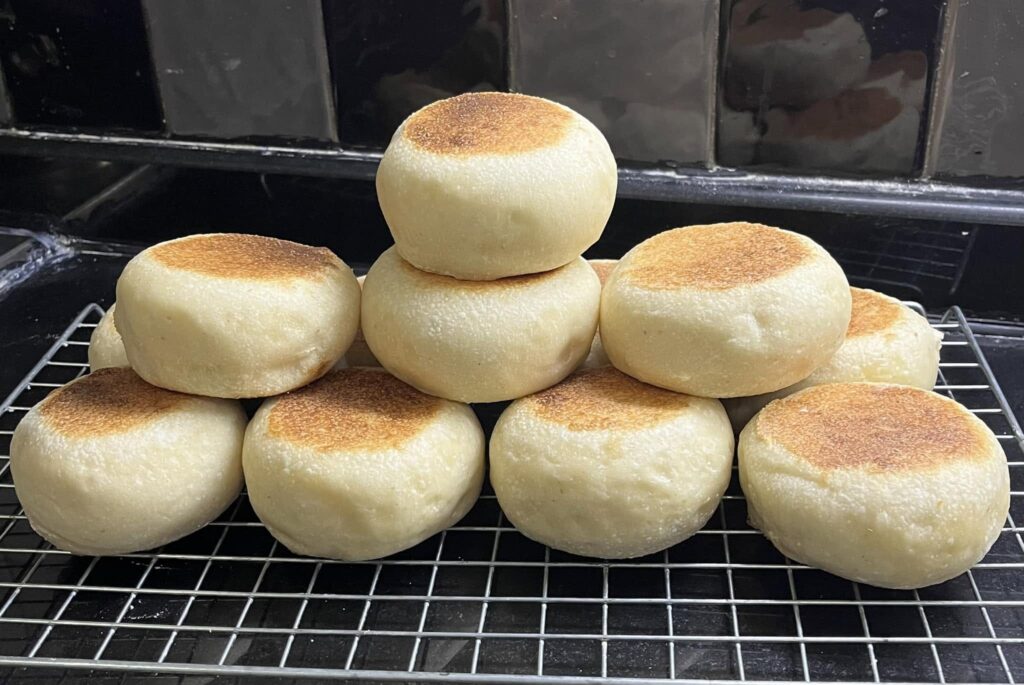

Homemade English Muffins
Prep time: 20 minutes
Rise time: 1½–2 hours
Cook time: 15–20 minutes
Total time: About 2½ hours
Makes: 8 English muffins
These homemade English muffins are soft and chewy inside with a lightly crisp, golden exterior and plenty of those classic nooks and crannies. They’re cooked on a skillet rather than baked, making them surprisingly simple to prepare at home.
Ingredients
- 3 cups (375 g) all-purpose flour
- 1½ tsp instant yeast
- 1 tbsp granulated sugar
- 1 tsp salt
- 1 cup (240 ml) warm milk
- 2 tbsp unsalted butter, melted
- 1 large egg
- ¼ cup (60 ml) warm water, as needed
- 2–3 tbsp cornmeal or semolina, for dusting
- Butter, for cooking
Instructions
1. Make the dough
In a large mixing bowl, combine the flour, instant yeast, sugar, and salt.
In a separate bowl, whisk together the warm milk, melted butter, and egg.
The milk should feel warm but not hot.
Pour the wet ingredients into the dry ingredients.
Mix with a wooden spoon or spatula until a shaggy dough forms.
If the dough seems unusually dry, add the warm water 1 tablespoon at a time.
You want a soft, slightly sticky dough.
2. Knead
Transfer the dough to a lightly floured work surface.
Knead for approximately 6–8 minutes, until the dough becomes smooth and elastic.
Alternatively, use a stand mixer fitted with a dough hook and knead on low-medium speed for about 5–6 minutes.
The dough should feel soft and spring back slowly when gently pressed.
3. First rise
Place the dough in a lightly greased bowl.
Cover with plastic wrap or a clean kitchen towel.
Leave it in a warm, draft-free place for approximately 1–1½ hours, or until roughly doubled in size.
The rising time will depend on the temperature of your kitchen.
4. Shape the muffins
Lightly dust a baking sheet or large tray with cornmeal or semolina.
Turn the risen dough onto a lightly floured surface.
Gently press out some of the air.
Divide the dough into 8 equal pieces.
Shape each piece into a smooth ball.
Flatten each ball gently until it’s approximately ¾ inch (2 cm) thick.
Don’t flatten them too much—the dough will rise again.
Place the rounds on the prepared tray.
Sprinkle the tops lightly with cornmeal or semolina.
5. Second rise
Cover the shaped muffins loosely with a clean towel.
Let them rest for approximately 30–45 minutes.
They should look noticeably puffier but don’t necessarily need to double in size.
Cook the English Muffins
6. Heat the skillet
Place a large heavy-bottomed skillet, cast-iron pan, or griddle over medium-low heat.
Lightly butter the cooking surface.
English muffins are cooked relatively slowly, so avoid high heat.
The outside can brown quickly while the center remains raw if the pan is too hot.
7. Cook
Carefully place the muffins in the skillet, leaving some room between them.
Cook for approximately 6–8 minutes on the first side.
The underside should become golden brown.
Flip gently.
Cook the other side for another 6–8 minutes.
If they’re browning too quickly, reduce the heat.
The center should be fully cooked.
If you have an instant-read thermometer, the internal temperature should be around 200–205°F (93–96°C).
8. Cool
Transfer the cooked muffins to a wire rack.
Allow them to cool for at least 10–15 minutes before splitting.
Cutting them while they’re piping hot can compress the interior.
The Best Way to Split Them
Don’t cut the muffins completely smoothly with a knife.
Instead, use a fork.
Insert the fork around the side of the muffin and pierce all the way around.
Gently pull the two halves apart.
This helps preserve the irregular holes and creates those classic nooks and crannies.
Toasting
Split the cooled English muffin.
Toast the cut sides until golden and crisp.
Spread generously with:
- Butter
- Jam
- Honey
- Peanut butter
- Cream cheese
For a savory breakfast, top with a fried egg, cheese, and bacon or sausage.
Tips for Great English Muffins
Keep the heat low
This is the most important cooking tip.
English muffins need enough time for the interior to cook while the exterior develops a golden crust.
Don’t overwork the dough
Knead until smooth and elastic, but don’t keep kneading unnecessarily.
Use a fork to split them
The fork-split method gives you a much more authentic texture than slicing them cleanly with a knife.
Don’t skip the second rise
The second rise makes the muffins lighter and helps create their characteristic airy interior.
Use cornmeal or semolina
A light coating keeps the dough from sticking and gives the outside a pleasantly textured finish.
Overnight English Muffins
For deeper flavor, let the dough rise slowly in the refrigerator.
After kneading, cover the bowl and refrigerate overnight.
The next morning, let the dough sit at room temperature for about 30–45 minutes, then shape and cook as directed.
The longer fermentation gives the muffins a more developed, slightly tangy flavor.
Storage
Store cooled English muffins in an airtight container or bag at room temperature for approximately 2–3 days.
For longer storage, freeze them for up to 3 months.
Split them before freezing so they can go directly into the toaster from frozen.
Serving Ideas
Classic Breakfast
Toast a split muffin and add:
Butter + scrambled eggs + cheddar + sausage
Eggs Benedict
Use toasted English muffin halves as the base for poached eggs, Canadian bacon, and hollandaise sauce.
Sweet Version
Toast and top with:
Butter + honey + cinnamon
or
Cream cheese + strawberry jam
Pizza Muffins
Top toasted halves with pizza sauce, mozzarella, pepperoni, and oregano.
Broil until the cheese is melted and bubbling.
The homemade muffins make an excellent base for quick breakfasts, sandwiches, and snacks.