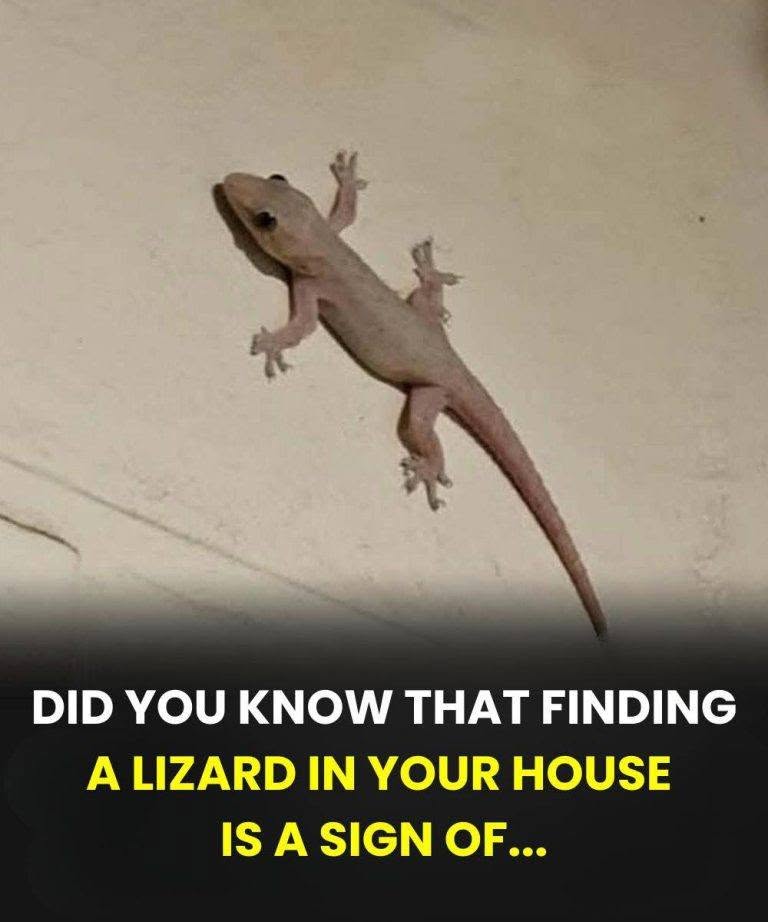

A lizard entering your home can carry different spiritual meanings depending on your culture, religious beliefs, and personal interpretation. In some traditions, lizards are associated with good luck, protection, transformation, and renewal. In others, they may be seen as warnings to pay attention to your surroundings.
The important thing to remember is that these are cultural beliefs and symbolic interpretations, not scientifically proven predictions. A lizard entering a house usually has an ordinary explanation: it may be looking for insects, warmth, shelter, or a safe place to hide.
1. Good luck and prosperity
In some folk traditions, seeing a lizard inside the home is interpreted as a sign of good fortune or a positive change approaching.
-
Symbolic meaning: New opportunities, prosperity, or a fresh beginning.
-
Common interpretation: The household may soon experience a period of growth or improvement.
These interpretations vary by region, and there is no universal belief that every lizard sighting brings good luck.
2. Transformation and renewal
Lizards can regrow their tails, making them natural symbols of recovery, adaptation, and renewal in some modern spiritual interpretations.
-
Symbolic meaning: Letting go of the past and beginning again.
-
Personal reflection: You may use the encounter as a reminder to adapt to change, recover from difficulties, or embrace a new chapter in life.
This is a symbolic association rather than evidence that the lizard has arrived to deliver a supernatural message.
3. Hindu and South Asian folk traditions
Cultural beliefs and folklore
In parts of India and South Asia, traditional omen-reading systems associate lizards with particular events. One example is Gauli Shastra, a folk tradition that interprets lizard movements, sounds, and encounters.
-
Good or bad omens: Interpretations may depend on the lizard’s movement, location, or interaction with a person.
-
Household symbolism: Some people view a lizard’s appearance as significant for family matters or future events.
-
Regional differences: The same encounter may be interpreted differently in different communities.
These beliefs are not universal Hindu teachings, and they should not be treated as reliable predictions.
In countries such as Thailand and the Philippines, geckos are familiar household animals, and folklore sometimes assigns meaning to their calls.
-
In some Thai folk beliefs, a gecko calling at a particular moment may be interpreted as a warning or an omen.
-
In some Filipino folklore, gecko sounds have been associated with visitors or incoming news.
The meanings differ by locality and circumstance. These are traditional interpretations, not evidence that geckos can predict the future.
5. Indigenous traditions in the Americas
Lizards appear in the stories and symbolism of several Indigenous peoples, but there is no single belief shared by all Indigenous cultures.
Some documented traditions associate particular lizards with healing, survival, protection, or creation. For example, lizards feature in the folklore of certain Plains and Southwestern peoples.
These meanings belong to specific cultural traditions and should not automatically be applied to every lizard entering a modern home.
6. Western spiritual interpretations
In contemporary Western spiritual writing, lizards are often used as symbols of resilience, intuition, and personal growth.
A lizard entering your home may be interpreted symbolically as an invitation to:
-
Pay attention to changes in your personal life.
-
Be patient before making important decisions.
-
Adapt when circumstances change.
-
Let go of habits that no longer serve you.
These are modern symbolic interpretations rather than established predictions about future events.
7. What does a lizard entering your home mean in Islam?
For Muslim readers, it is important to distinguish Islamic teachings from local superstitions.
Islamic hadith literature discusses the wazagh, commonly understood as a gecko. For example, Sahih al-Bukhari 3307 contains a narration concerning geckos. However, this does not establish that a gecko entering your home is a sign of impending wealth, misfortune, death, or the presence of jinn.
A scholarly answer from Darul Uloom Trinidad and Tobago explicitly rejects the claim that ordinary house lizards are themselves jinn.
You do not need to fear that a lizard entering your house means something bad will happen. If you are concerned, follow your usual religious practices for peace of mind rather than relying on omens.
8. Does the room where the lizard appears change its spiritual meaning?
In popular spiritual interpretations, people sometimes attach different meanings to the room in which an animal appears. These interpretations are not universal or scientifically established.
| Location | Common symbolic interpretation |
|---|---|
| Living room | Family life and relationships |
| Bedroom | Personal reflection and privacy |
| Kitchen | Nourishment and daily routines |
| Near a door or window | Transitions or new opportunities |
| Bathroom | Cleansing or letting go |
Use these associations as optional prompts for reflection, not as predictions. A lizard in the kitchen is not proof of financial change, and one in a bedroom is not proof of a spiritual disturbance.
9. What should you do if a lizard enters your home?
There is no need to panic or assume that it carries a supernatural message.
-
Stay calm and avoid handling it with bare hands.
-
If possible, let it leave through an open door or guide it outside safely.
-
Seal gaps around windows and doors if lizards frequently enter.
-
Reduce insects indoors, since they are a common food source for house geckos.
-
If the encounter has personal spiritual significance for you, reflect on it without assuming that it predicts an event.
Final thoughts
Across different cultures, a lizard entering a home may be associated with good fortune, protection, renewal, warnings, or spiritual symbolism. But these meanings vary considerably, and no single interpretation applies to everyone.
The most balanced interpretation is that a lizard can inspire personal reflection without being a sign of either good or bad luck. In everyday life, it is usually just a small animal looking for food or shelter.