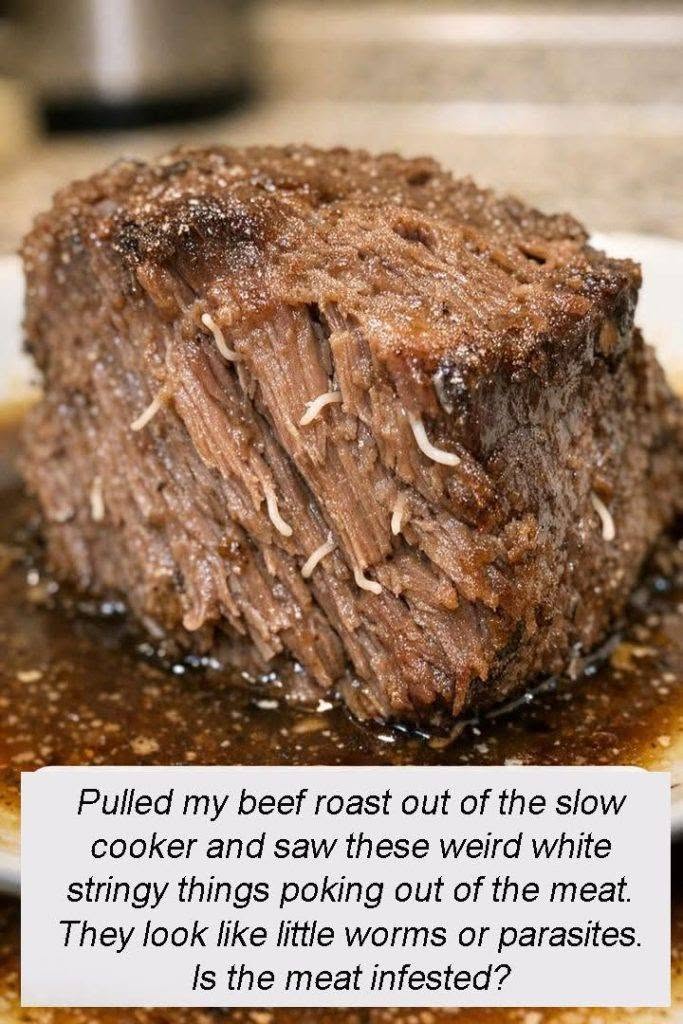

White Stringy Things in a Slow-Cooked Beef Roast: Are They Parasites?
Finding thin white strands sticking out of a beef roast can be alarming, especially when they resemble little worms. Fortunately, in cooked beef, white stringy material is much more likely to be connective tissue, collagen, or a piece of fat or sinew than a parasite.
What You May Be Seeing
Beef contains connective tissues that hold muscle fibers together. Some of these tissues can appear as thin, white or translucent strands.
During slow cooking, collagen gradually breaks down into gelatin. However, thicker pieces of connective tissue may remain intact and become soft, stringy, or fibrous.
A roast can also contain sinew or silverskin, which may become more noticeable after cooking.
Why It Can Look Like a Worm
Connective tissue can separate into long strands as the meat cooks and is pulled apart. Because it can be white, flexible, and string-like, it may look surprisingly similar to a worm.
Appearance alone isn’t enough to identify something as a parasite.
What About Beef Parasites?
Some parasites can infect cattle, but the things people notice in cooked beef are not typically long white worms sticking out of ordinary roast meat.
Proper cooking is important for reducing the risk from foodborne parasites and bacteria. Whole beef roasts should be cooked to a safe internal temperature, and using a food thermometer is much more reliable than judging doneness by appearance.
Don’t Eat Meat That Looks or Smells Spoiled
If the roast has an unusual rotten odor, slimy texture, unexpected discoloration, or other signs of spoilage, don’t taste it to determine whether it is safe. When food appears spoiled, the safest option is to discard it.
If the meat simply has a few white fibrous strands but otherwise looks and smells normal, those strands are much more likely to be connective tissue than parasites.
If You Have a Photo
A close-up photograph can help distinguish between fibrous connective tissue, fat, sinew, and other possibilities. However, a photograph cannot reliably confirm whether something is a parasite.
If you still have the roast, you can photograph one of the white strands next to a coin or ruler for scale, without touching or tasting it.
The Bottom Line
White stringy material in a slow-cooked beef roast is usually connective tissue, collagen, sinew, or fat—not an infestation. Slow cooking can make these structures separate from the meat and become much more noticeable.
If the meat was cooked and handled properly and has no signs of spoilage, the strange-looking strands alone are not evidence that the roast was infested.