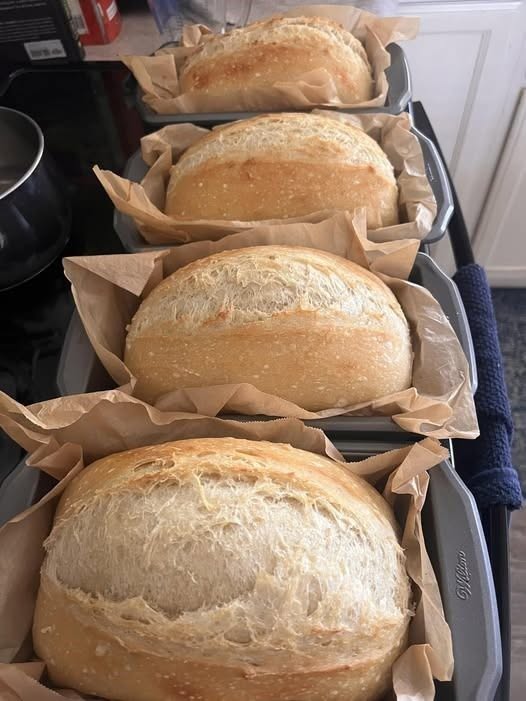

Easy No-Knead Bread
Prep time: 10 minutes
Rise time: 12–18 hours
Bake time: 45–50 minutes
Total time: About 13–19 hours
Makes: 1 large loaf
This classic no-knead bread has a crisp, deeply golden crust and a soft, chewy interior full of airy holes. The secret is a very wet dough and a long, slow rise—so there’s almost no hands-on work.
Ingredients
- 3 cups (390 g) all-purpose or bread flour
- 1½ tsp salt
- ½ tsp instant yeast
- 1½ cups (360 ml) warm water
- 1 tsp honey or sugar, optional
- Extra flour or cornmeal, for shaping
Instructions
1. Mix the dough
Add the flour, salt, and instant yeast to a large mixing bowl.
If using honey or sugar, stir it into the warm water.
Pour the water into the flour mixture.
Using a wooden spoon or sturdy spatula, mix until all the flour is moistened.
The dough will look rough, sticky, and shaggy. That’s exactly what you want.
Don’t knead it.
2. Cover and let it rise
Cover the bowl tightly with plastic wrap or a lid.
Leave it at room temperature for 12–18 hours.
A cooler kitchen may require closer to 18 hours, while a warm kitchen may need less.
The dough is ready when it has expanded substantially and the surface is covered with bubbles.
3. Prepare the dough
Generously flour your work surface.
Scrape the dough onto the flour.
The dough will be sticky, so use a bench scraper or lightly floured hands.
Gently fold the edges toward the center a few times to form a rough round loaf.
Don’t knead or press the air out.
4. Rest the dough
Place a sheet of parchment paper on your work surface and dust it lightly with flour.
Transfer the dough onto the parchment, seam-side down.
Sprinkle the top with a little flour.
Cover loosely with a clean kitchen towel.
Let it rest for approximately 30–45 minutes.
Meanwhile, preheat the oven.
Bake in a Dutch Oven
5. Preheat the pot
Place a 4–6 quart Dutch oven with its lid inside the oven.
Preheat the oven to 450°F (230°C) for at least 30 minutes.
The Dutch oven needs to become very hot.
6. Transfer the dough
Carefully remove the hot Dutch oven.
Using the parchment as a sling, lower the dough into the pot.
Be extremely careful—the pot will be very hot.
You can score the top with a sharp knife or bread lame if desired.
A simple cross or one long slash is enough.
7. Bake covered
Put the lid on the Dutch oven.
Bake at 450°F (230°C) for 30 minutes.
Keeping the lid on traps steam, which allows the loaf to develop its characteristic crisp crust while expanding in the oven.
8. Bake uncovered
Remove the lid.
Continue baking for another 15–20 minutes, until the bread is a deep golden brown.
For a darker, crunchier crust, bake toward the longer end of the range.
9. Cool completely
Carefully remove the loaf from the Dutch oven.
Transfer it to a wire rack.
Let it cool for at least 1 hour before slicing.
It may be tempting to cut into it immediately, but the interior is still setting as it cools.
Cutting too early can result in a gummy crumb.
How to Know It’s Done
A fully baked loaf should:
- Have a deep golden-brown crust
- Sound hollow when tapped underneath
- Feel light for its size
- Have an internal temperature around 200–210°F (93–99°C)
Tips for Excellent No-Knead Bread
Don’t add too much flour
The dough should be quite wet and sticky.
Adding lots of flour makes the finished bread dense.
Use flour mainly to prevent the dough from sticking to your hands and work surface.
Give it enough time
The long fermentation is what develops the flavor and gluten structure.
If your kitchen is cool, let it rise closer to 18 hours.
Use a very hot Dutch oven
Preheating the Dutch oven is important.
The hot surface gives the dough an immediate burst of heat and helps produce a beautiful crust.
Don’t skip the covered bake
The trapped steam is crucial during the first part of baking.
It keeps the crust flexible while the loaf expands.
Overnight Schedule
For an easy morning-to-evening schedule:
8:00 PM: Mix the dough.
8:10 PM: Cover and leave at room temperature.
8:00 AM: Shape the dough.
8:30 AM: Preheat the oven and Dutch oven.
9:00 AM: Bake.
9:45 AM: Remove the loaf.
10:45 AM: Slice and serve.
Flavor Variations
Garlic & Herb
Add to the dry ingredients:
- 1 tsp garlic powder
- 1 tsp dried Italian herbs
- 1 tbsp chopped fresh rosemary
Cheddar Jalapeño
Fold into the dough after the initial rise:
- 1 cup shredded sharp cheddar
- 1–2 finely chopped jalapeños
Bake as directed.
Rosemary Olive Oil
Add:
- 1 tbsp chopped fresh rosemary
- 1 tbsp olive oil
Serve warm with additional olive oil for dipping.
Cinnamon Raisin
Add:
- 1 tsp cinnamon
- ½ cup raisins
- 2 tbsp brown sugar
This version makes a wonderful breakfast toast.
If You Don’t Have a Dutch Oven
You can still bake the bread.
Place the shaped dough on a parchment-lined baking sheet.
Put a metal pan on the bottom rack of the oven while preheating.
When you put the bread in, carefully pour about 1 cup of boiling water into the hot metal pan to create steam.
Bake at 450°F (230°C) for approximately 35–45 minutes.
The crust won’t be quite as thick as the Dutch-oven version, but you’ll still get a delicious loaf.
Storage
Store the completely cooled loaf at room temperature in a paper bag or loosely wrapped kitchen towel for 2–3 days.
Avoid storing it in the refrigerator, which can make bread stale faster.
For longer storage, slice the loaf and freeze it in an airtight freezer bag for up to 3 months.
Toast slices directly from frozen.
Serving Ideas
Serve thick slices warm with butter, or use the bread for:
- Avocado toast
- Grilled cheese
- French toast
- Breakfast sandwiches
- Soup and stew
- Bruschetta
- Dipping in olive oil and herbs
For the classic experience, tear off a piece while the crust is still crisp and serve it with salted butter or extra-virgin olive oil.