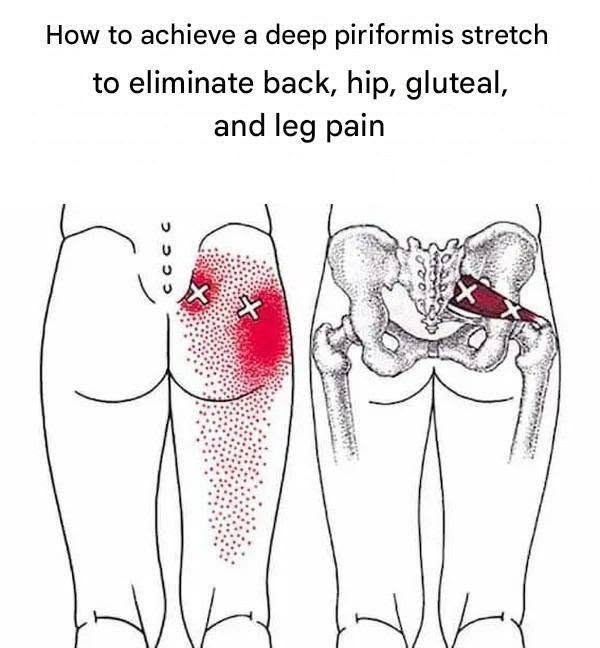

How to Achieve a Deep Piriformis Stretch for Back, Hip, Gluteal, and Leg Pain
The piriformis muscle is a small muscle deep in the buttock that helps rotate and stabilize the hip. Stretching it may relieve tightness in some people, particularly when discomfort is related to the hip or buttock. However, it is not a guaranteed way to eliminate back or leg pain, because those symptoms can have many different causes.
1. Supine Figure-4 Stretch
This is one of the gentlest ways to stretch the piriformis.
-
Lie on your back with both knees bent and your feet on the floor.
-
Place your right ankle over your left thigh, just above the knee.
-
Keep your right foot flexed.
-
Slowly bring your left thigh toward your chest.
-
Reach through and gently pull the left thigh toward you.
-
You should feel a stretch deep in the right buttock, not sharp pain in the knee or back.
-
Hold for 20–30 seconds, breathing normally.
-
Release slowly and repeat on the other side.
-
Perform 2–3 repetitions per side.
2. Seated Piriformis Stretch
-
Sit upright in a sturdy chair.
-
Place one ankle over the opposite knee.
-
Keep your back relatively straight.
-
Hinge forward slightly from your hips.
-
Stop when you feel a comfortable stretch in the buttock.
-
Hold for 20–30 seconds and repeat 2–3 times.
Avoid forcing your knee downward.
3. Gentle Supine Variation
For a deeper—but still controlled—stretch, perform the figure-4 position and gradually bring the supporting thigh stretch isn’t necessarily more effective. Aggressively pulling closer to your chest. The goal is a mild-to-moderate stretch, not maximum intensity.
A stronger stretch isn’t necessarily more effective. Aggressively pulling the leg can irritate the hip, lower back, or surrounding nerves.
What You Should Feel
A normal stretch usually feels like gentle tension or pulling in the buttock/hip. Stop if you experience:
-
Sharp or stabbing pain
-
Increasing numbness or tingling
-
Burning or electrical pain traveling down the leg
-
Significant pain in the knee or hip
-
New weakness
Important: Don’t Assume It’s the Piriformis
Pain traveling from the back or buttock into the leg can also arise from lumbar spine problems, nerve irritation, hip disorders, or other conditions. Stretching the piriformis won’t necessarily treat those causes.
Seek urgent medical attention for back/leg pain accompanied by new bowel or bladder problems, numbness around the groin/saddle area, or significant or progressive leg weakness.
A Better Approach
Rather than trying to achieve the deepest possible stretch, start gently and combine mobility with gradual strengthening of the hips and core. If your pain persists, repeatedly returns, or travels down the leg, a physiotherapist or other healthcare professional can assess the underlying cause and tailor exercises to you.