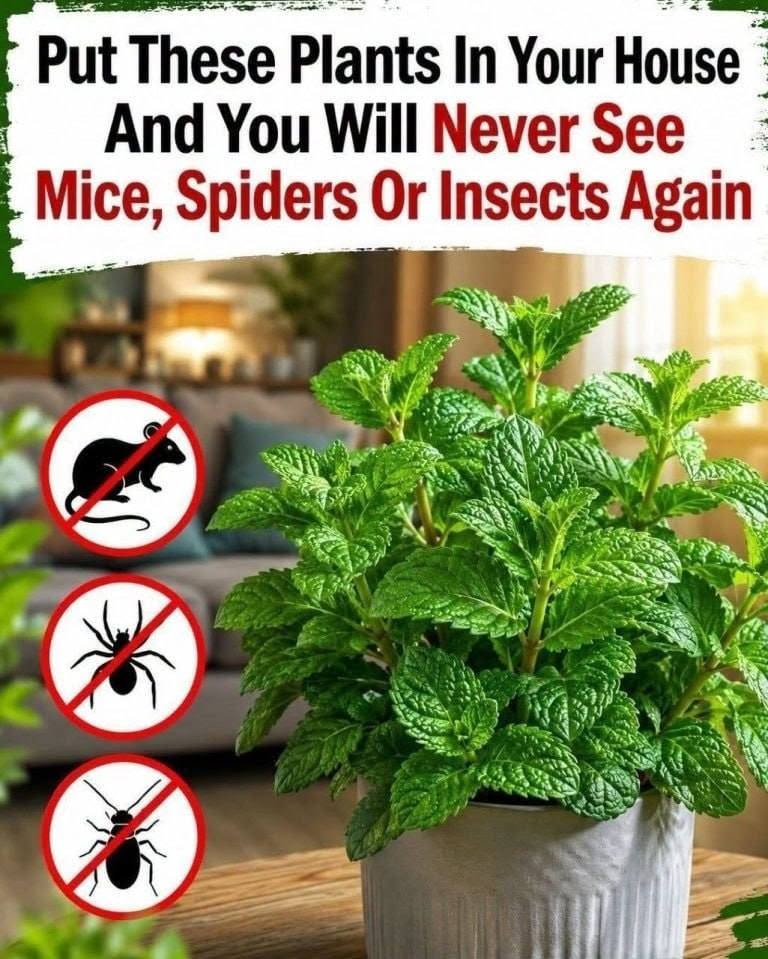

8 Plants That May Help Repel Mice, Spiders, and Other Insects
Certain strongly scented plants are commonly used around homes because their aromas may discourage some insects and other pests from lingering nearby. However, plants are not a guaranteed pest-control solution, and evidence varies depending on the pest and plant.
For mice and larger pests, sealing entry points and removing food sources is usually much more effective than relying on plants alone.
1. Peppermint
Peppermint has a strong menthol-like aroma that many people use around areas where insects or rodents are unwanted. Growing peppermint in containers near doors, windows, or patios can add fragrance while potentially discouraging some pests.
Because peppermint spreads aggressively, keeping it in a pot can make it easier to control.
2. Lavender
Lavender has a strong natural fragrance and is commonly grown near windows, patios, and entrances. Its scent may help discourage certain flying insects.
It also attracts pollinators such as bees and butterflies, making it a useful ornamental plant for gardens.
3. Rosemary
Rosemary produces a distinctive aromatic scent from its natural oils. Growing it near outdoor seating areas or entrances may help make the area less attractive to some insects.
It also works well as a culinary herb.
4. Basil
Basil has a strong scent that may help discourage some insects around outdoor areas. Keeping pots of basil near a sunny kitchen window or patio can provide both a useful herb and a fragrant plant.
5. Lemongrass
Lemongrass contains aromatic compounds that are widely used in insect-repellent products. Growing it around outdoor spaces can provide a pleasant citrus scent, although simply having the plant nearby should not be considered equivalent to using a tested repellent.
6. Mint
Different types of mint have strong aromas that may discourage some insects. Like peppermint, mint can spread rapidly, so container growing is often easier to manage.
7. Marigolds
Marigolds are popular garden plants and are sometimes promoted as natural insect repellents. Their usefulness varies depending on the pest and growing conditions, so they should be viewed as one part of an overall garden-management strategy rather than a guaranteed barrier.
8. Catnip
Catnip contains a compound called nepetalactone that has demonstrated insect-repellent properties in research. However, its effectiveness in an ordinary home garden will vary.
One important consideration is that catnip can attract cats, so it may not be ideal for every household.
What About Mice?
Plants alone are unlikely to solve a mouse infestation. If mice are entering your home, concentrate on practical prevention:
- Seal cracks and gaps around doors, windows, pipes, and foundations.
- Keep food in tightly closed containers.
- Clean crumbs and food spills promptly.
- Keep garbage securely covered.
- Reduce clutter where rodents can hide.
- Address leaks and other sources of accessible water.
The Bottom Line
Aromatic plants such as peppermint, lavender, rosemary, basil, lemongrass, mint, marigolds, and catnip can be pleasant additions to a home or garden and may discourage certain pests in some circumstances.
But don’t rely on plants alone for serious infestations. For mice and persistent insect problems, removing food sources, sealing entry points, and using appropriate pest-control measures are much more reliable.