
New method: colonoscopy will no longer be an invasive examination. (1/2)
The phrase “New method: colonoscopy will no longer be an invasive examination” typically refers to emerging, minimally invasive or completely non-invasive technologies designed to replace or reduce the need for traditional scope-based colonoscopies—especially for routine colorectal cancer screening.
Because you pasted
(1/2) (which usually indicates a two-part message or social media/news headline), I don’t yet have the specific study or device name from part (2/2). However, here is a detailed breakdown of the major “non-invasive colonoscopy” breakthroughs that headlines like this refer to:1. Colon Capsule Endoscopy (“Pill Camera” / Smart Capsules)
Instead of inserting a long, flexible tube (colonoscope) through the rectum under sedation, the patient simply swallows a vitamin-sized capsule containing miniaturized cameras, LED lights, a battery, and a wireless transmitter.
-
How it works: As natural muscle contractions (peristalsis) move the capsule through the digestive tract over 8 to 12 hours, it captures tens of thousands of high-resolution images and transmits them to a wearable data recorder. Newer AI-assisted versions automatically flag polyps and suspicious lesions for doctors to review.
-
What’s new in recent breakthroughs: Researchers have developed magnetically guided capsules (controlled externally by a physician using a magnetic field) and tether-free robotic capsules that can pause, inspect tissue closely, or even take tiny micro-samples without requiring anesthesia.
-
Limitations: Bowel preparation (laxatives to clean out the colon) is still required, and if the camera spots a polyp, a traditional colonoscopy is still needed to remove it.
2. Virtual Colonoscopy (CT Colonography)
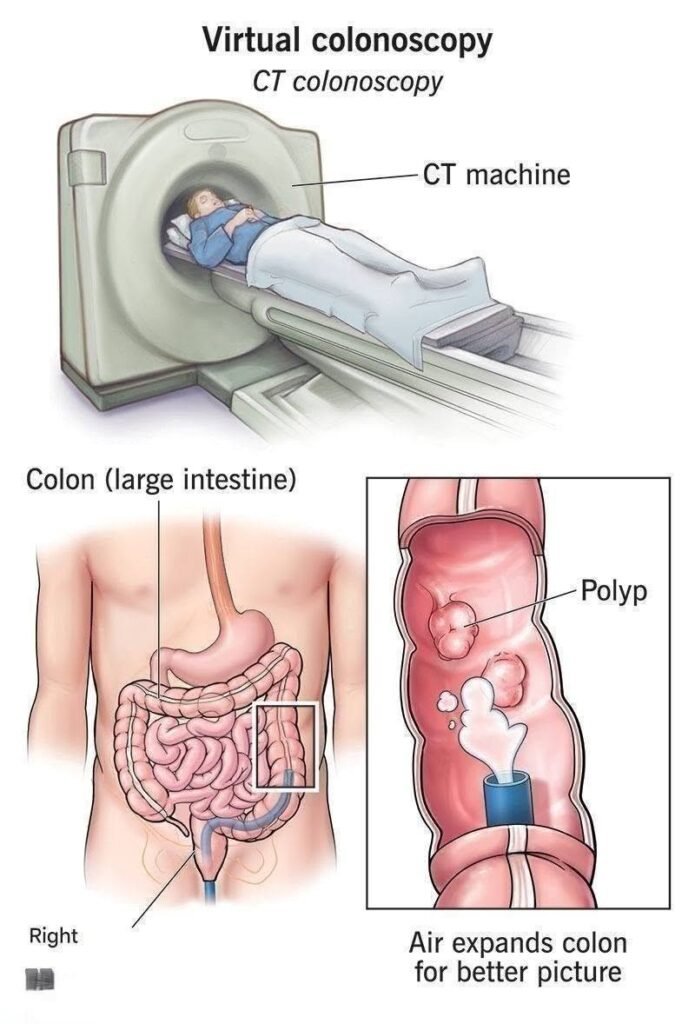
This imaging-based method uses low-dose computed tomography (CT) X-rays and advanced 3D reconstruction software to inspect the entire large intestine from outside the body.
-
How it works: No sedation or long endoscope is used. A radiologist inserts a very short, thin catheter just inside the rectum to gently inflate the colon with carbon dioxide (so folds flatten out), then takes rapid CT scans while you hold your breath for about 10–15 seconds. Software stitches the slices into a 3D “fly-through” video of the colon interior.
-
Advantages: Takes roughly 15 minutes, requires zero recovery time, and carries almost no risk of colon perforation.
3. Next-Generation Liquid Biopsies & Stool Molecular Tests
A major reason colonoscopy is becoming “non-invasive” for initial screening is that molecular diagnostics now catch precancerous changes before a camera is ever needed:
-
Blood-Based Screening Tests (e.g., Shield / ctDNA tests): A routine blood draw detects circulating tumor DNA (ctDNA) and specific methylation patterns shed by colorectal tumors into the bloodstream.
-
Multi-Target Stool DNA & RNA Tests (e.g., Cologuard Plus, ColoSense): Performed entirely at home using a stool sample, these tests look for altered human DNA, RNA biomarkers, and microscopic blood associated with polyps and cancer.
-
AI Gut Microbiome Analysis: Newer experimental methods analyze bacterial DNA signatures in stool samples using machine learning to predict early colorectal polyps with high sensitivity.
Quick Comparison
| Method | Invasive Scope? | Sedation Needed? | Bowel Prep Needed? | Can Remove Polyps? |
| Traditional Colonoscopy | Yes | Yes | Yes | Yes (during exam) |
| Colon Capsule (“Pill Cam”) | No (swallowed) | No | Yes | No |
| Virtual Colonoscopy (CT) | Minimal (short tip) | No | Yes | No |
| Blood / Stool DNA Tests | No | No | No | No |
Important Clinical Caveat: All non-invasive alternatives are screening tools. If any of these methods detects a polyp or abnormal biomarker, a standard therapeutic colonoscopy is still required afterward to remove the polyp and perform a biopsy.
If you have part (2/2) of the text or article you were sharing, paste it here and I can give you the exact details on that specific method!