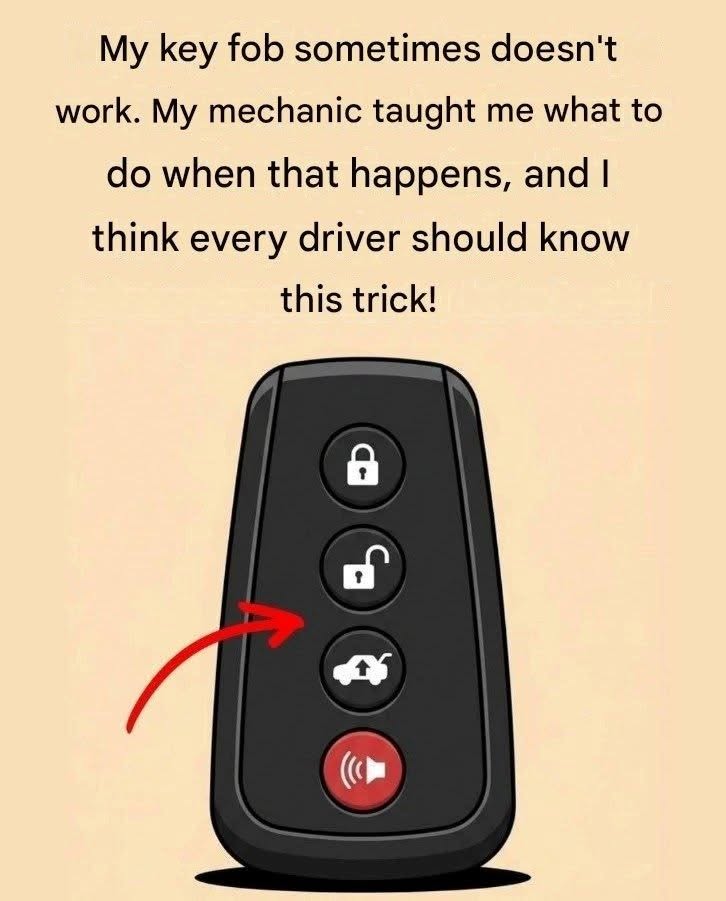

If your car key fob suddenly stops working, don’t panic! You may not need a new key or an expensive visit to the mechanic. Sometimes the problem is as simple as a weak battery, radio interference, or a temporary issue with the car’s locking system.
Here are several practical tricks you can try, step by step.
1. Replace the key fob battery
The most common cause of a key fob not working is a weak or dead battery.
What to do:
-
Check your car’s owner’s manual to find the correct battery type, such as CR2032 or CR2025. These are examples; your fob may use a different battery.
-
Look for a small notch or seam along the edge of the fob.
-
Carefully open the casing with the recommended tool, avoiding damage to the plastic clips.
-
Remove the old battery and note which side faces up.
-
Insert a fresh battery of the correct type, ensuring the contacts are clean and properly positioned.
-
Close the casing and test the lock and unlock buttons near your car.
Helpful tip: Avoid touching the battery’s contact surfaces unnecessarily, and don’t force the case open. Some fobs require a particular opening technique.
2. Use the physical key hidden inside the fob
Many modern car key fobs contain a small mechanical key for emergencies.
How to use it:
-
Look for a release button, switch, or sliding latch on the fob.
-
Release the hidden metal key.
-
Find the driver’s door lock. On some vehicles, it is concealed beneath a small cover on the door handle.
-
Unlock the door manually.
Be aware that opening the door manually may trigger the car alarm. Your owner’s manual will explain how to disarm it.
3. Hold the fob against the start button
If your car has push-button start and the fob battery is weak, the vehicle may still recognize the key at very close range.
Try this:
-
Sit in the driver’s seat with the key fob inside the vehicle.
-
Press the brake pedal as usual.
-
Hold the fob directly against the engine start/stop button, or position it at the emergency detection point specified in your owner’s manual.
-
Press the start button.
The exact procedure varies by make and model. Some vehicles use a designated spot in the center console, steering column, or another location instead.
Why it works: Many vehicles have a backup near-field key detection system that can recognize the fob even when its battery is too weak for normal remote operation.
4. Try the fob closer to the car
Sometimes the fob works intermittently because its battery is weak or the radio signal is being disrupted.
-
Stand close to the driver’s door.
-
Point the fob toward the vehicle, if your model’s design makes this helpful.
-
Press the unlock button once.
-
Try another door if the driver’s door does not respond.
If the fob works only when you stand very close to the car, its battery may need replacement, or there may be a problem with the fob’s transmitter.
5. Move away from possible radio interference
Nearby electronics or radio transmitters can sometimes interfere with a car’s remote key signal.
Try this simple test:
-
Move the car away from the immediate area if it is safe and practical.
-
Move away from other electronic devices or strong radio sources.
-
Test the fob again.
-
If it works elsewhere, interference may have been the cause.
Commonly suspected sources include some wireless devices, electronic security equipment, and radio transmitters. The exact cause depends on the vehicle and local environment.
6. Check whether the car battery is dead
A key fob can be working perfectly while the car itself has a discharged 12-volt battery.
Look for these signs:
-
The dashboard lights do not turn on.
-
The interior lights are unusually dim or completely off.
-
The central locking system does not respond.
-
The engine does not crank, or the car displays a low-voltage warning.
If several electrical systems fail simultaneously, the vehicle battery may be the problem rather than the key fob.
Follow your vehicle’s manual for safe battery testing or jump-starting. If you’re unsure, contact roadside assistance.
7. Try a spare key fob
If you have a spare, test it next.
-
Spare works, original doesn’t: The original fob’s battery, buttons, circuit board, or programming may be faulty.
-
Neither fob works: The vehicle’s battery, receiver, central locking system, or surrounding radio environment may be responsible.
-
Both work intermittently: Consider interference or a vehicle electrical issue.
This is one of the quickest ways to narrow down the problem.
8. Check for a stuck or damaged button
A key fob can stop responding because a button is jammed, worn out, or damaged by moisture.
Inspect the fob for:
-
Buttons that remain pressed down.
-
Cracked or loose casing.
-
Signs of water damage.
-
Corrosion around the battery contacts.
If it has been exposed to liquid, stop pressing the buttons repeatedly. Remove the battery if you can do so safely, and have the fob inspected. Do not heat it with a hair dryer or place it in an oven.
9. Check whether the fob needs reprogramming
Some vehicles may require key reprogramming after certain repairs, battery-related issues, or electronic faults. However, replacing the coin-cell battery in most ordinary key fobs does not automatically erase the programming.
If a fresh battery doesn’t solve the problem, consult your owner’s manual or a qualified automotive locksmith. Programming procedures differ significantly between vehicles, and some require specialist equipment or proof of ownership.
10. Know when it’s time for professional repair
Seek professional help if:
-
The fob has been dropped and no longer works.
-
The circuit board is visibly damaged or corroded.
-
A fresh, correctly installed battery makes no difference.
-
The vehicle fails to recognize both the original and spare keys.
-
A dashboard warning indicates a key-recognition or immobilizer fault.
A qualified automotive locksmith or dealership can test the fob’s signal, check the vehicle’s receiver, and determine whether repair, replacement, or reprogramming is necessary.
Quick troubleshooting guide
| Problem | What to try first |
|---|---|
| Fob works only at close range | Replace the fob battery |
| Buttons do nothing | Check battery installation and contacts |
| Doors won’t unlock, but dashboard works | Try the mechanical key and test the fob |
| Car won’t start, but doors unlock | Use the emergency start procedure in the manual |
| No dashboard lights or interior lights | Check the vehicle’s 12-volt battery |
| Spare key works normally | Inspect or replace the faulty fob |
| Both keys fail in one location | Check for interference or a vehicle-side fault |
Most important advice: Start by checking the fob battery, then try the hidden mechanical key and emergency start procedure. These simple steps can often identify the problem without replacing the entire key.